
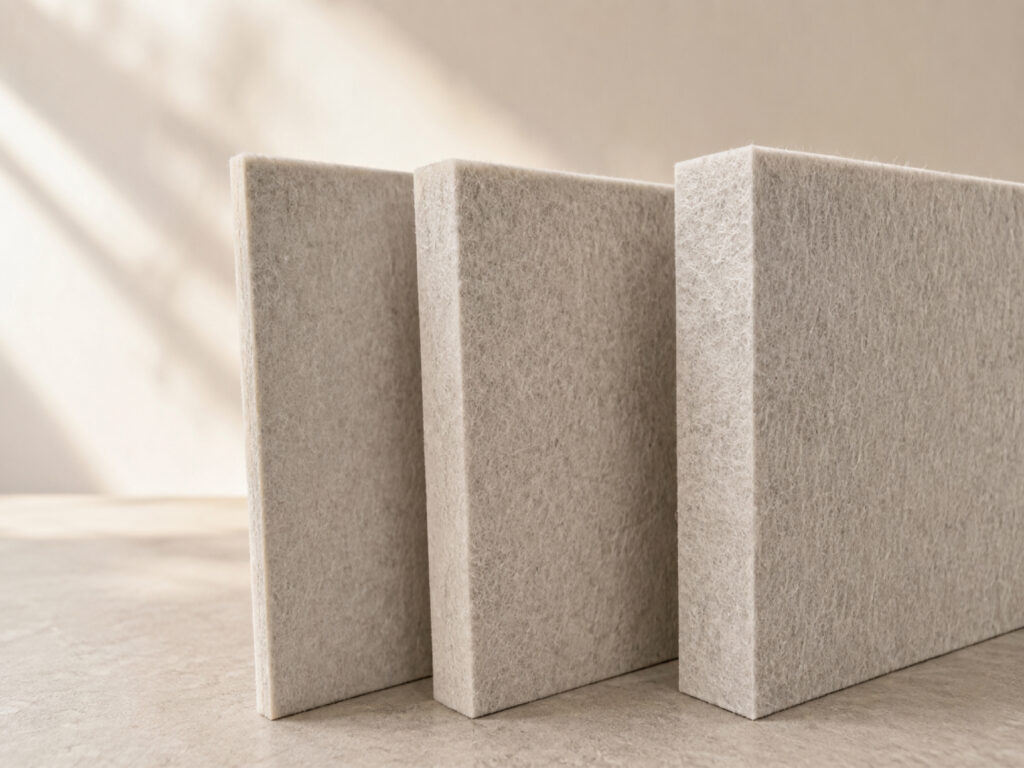
Does Acoustic Panel Thickness Really Matter? A Practical Guide
Yes, acoustic panel thickness matters because it can influence how effectively a panel absorbs sound across different frequencies. However, thicker does not automatically mean better for every room. Material density, installation method, air gaps, placement, and the acoustic problem being addressed should also be considered.
Therefore, choosing the right acoustic panel thickness is less about finding the thickest product and more about matching the panel to the needs of the space.
How Does Acoustic Panel Thickness Affect Sound Absorption?
In general, increasing acoustic panel thickness can improve sound absorption, particularly at lower frequencies. This happens because a thicker layer of absorptive material gives sound energy more material to interact with before it is reflected back into the room.
However, thickness is only one part of acoustic performance. Two panels with the same thickness may perform differently because their materials, density, construction, and installation methods are different.
For this reason, thickness should not be used as the only measurement of panel quality.
Are Thicker Acoustic Panels Always Better?
No. Thicker acoustic panels are not automatically the best choice for every application.
For example, a meeting room that mainly needs better speech clarity may have different acoustic requirements from a large restaurant with a high ceiling and many hard surfaces.
In addition, extremely thick panels may not be necessary when the main goal is to control reflections in the speech-frequency range. The room itself should be evaluated before the panel thickness is selected.
Ultimately, the best acoustic solution balances performance, available space, design requirements, and budget.
What Thickness Should Acoustic Panels Be?
There is no single acoustic panel thickness that is ideal for every room. The appropriate thickness depends on the type of panel, its tested acoustic performance, the frequencies that need to be controlled, and how the product will be installed.
Before choosing a panel, consider:
- Room size and ceiling height
- Amount of glass, concrete, tile, and other reflective surfaces
- Primary sound sources
- Intended use of the room
- Available wall or ceiling space
- Tested acoustic performance
- Installation method
For example, an office focused on speech clarity may require a different solution from a studio or entertainment space where a wider frequency range needs to be controlled.
Does an Air Gap Behind an Acoustic Panel Matter?
Yes. In some acoustic panel systems, an air gap between the panel and the wall or ceiling can affect sound absorption performance.
Instead of being installed directly against a hard surface, certain absorptive panels can be positioned with space behind them. Depending on the panel and installation system, this configuration may improve absorption at some frequencies.
Consequently, when comparing acoustic products, it is important to check not only the material itself but also the installation conditions under which its acoustic performance was tested.
Is NRC More Important Than Acoustic Panel Thickness?
NRC and panel thickness provide different information, so one should not simply replace the other.
The Noise Reduction Coefficient (NRC) is a single-number rating derived from sound absorption measurements at specified frequencies. Thickness, on the other hand, is a physical characteristic of the product.
Therefore, a thicker panel should not automatically be assumed to have a higher NRC. When comparing products, tested acoustic performance should be reviewed alongside thickness, material construction, and installation conditions.
Learn more about Noise Reduction Coefficient (NRC) and how it is used to compare acoustic materials.
Sound absorption measurements are commonly performed using standardized test methods such as ASTM C423, which evaluates sound absorption in a reverberation room.
Does PET Acoustic Panel Thickness Matter?
Yes. PET acoustic panel thickness can influence acoustic performance, but the complete construction of the panel should also be considered.
PET acoustic panels are made from compressed polyester fiber and are available in different densities, dimensions, and thicknesses. As a result, products that look similar may not necessarily provide identical acoustic performance.
Furthermore, PET panels can be used as both functional acoustic treatment and decorative interior elements. Color, pattern, shape, and installation design can be customized while acoustic requirements are considered.
Explore our PET Acoustic Panels for more information about available acoustic solutions.
Where Should Thicker Acoustic Panels Be Considered?
Thicker acoustic treatment may be useful in spaces where broader sound absorption is required. However, the decision should always be based on the acoustic conditions of the room.
Potential applications include:
- Large meeting and conference rooms
- Restaurants with high ceilings
- Open-plan offices
- Educational facilities
- Recording and media spaces
- Large commercial interiors
Nevertheless, adding thicker panels without considering placement and coverage may not solve the original acoustic problem.
Read Where Should Acoustic Panels Be Installed? Wall vs Ceiling to understand why placement matters.
Frequently Asked Questions About Acoustic Panel Thickness
Does a thicker acoustic panel absorb more sound?
It can, particularly at lower frequencies, but thickness alone does not determine acoustic performance. Material properties, density, installation, and air gaps can also influence sound absorption.
Is a 25 mm acoustic panel better than a 12 mm panel?
Not necessarily in every situation. The products should be compared using tested acoustic data and their intended applications rather than thickness alone.
Can thin acoustic panels reduce echo?
Yes. Depending on their acoustic performance and installation, thinner panels may still help reduce reflected sound and reverberation, particularly within certain frequency ranges.
Does acoustic panel density matter?
Yes. Density can influence acoustic performance, but higher density does not automatically mean better absorption at every frequency. The complete panel construction and test results should be considered.
Should I choose acoustic panels based only on NRC?
No. NRC is useful for comparing sound absorption, but thickness, frequency-specific performance, installation method, placement, and room conditions should also be evaluated.
So, Does Acoustic Panel Thickness Really Matter?
Yes, acoustic panel thickness matters, but it is only one factor that determines acoustic performance.
A thicker panel may provide improved absorption across certain frequencies, particularly toward lower frequencies. However, choosing the thickest available product without considering the room, material, installation method, and tested performance may lead to unnecessary cost without solving the actual acoustic problem.
Therefore, the best approach is to select acoustic treatment according to the requirements of the space rather than thickness alone.
About TYNE New Material Technology
TYNE New Material Technology (Thailand) Co., Ltd. is a leading manufacturer specializing in the production of interior acoustic panels and the assembly of acoustic modules. Located in Thailand, our 6,000 sqm factory employs advanced technology, including automatic production lines for polyester panels and CNC cutting equipment, to deliver a diverse range of products. From standard engineering sheets to DIY sound-absorbing kits, we cater to global markets to meet your business needs.
We adhere to strict ISO 9001:2015 quality management systems, ensuring that every container shipped meets international standards for fire safety (ASTM E84 Class A or EN 13501 Class B) and low formaldehyde emissions. Our commitment to eco-friendly production involves using recycled PET materials to create sustainable, high-quality acoustic solutions that elevate industry standards.
Looking for OEM acoustic panel manufacturing services? Contact TYNE to discuss custom acoustic panel solutions for your brand or project.
Contact us
Call: +(66) 65-237-5578
Email: support@tyneacoustic.com
Website: tyneacoustic.com