
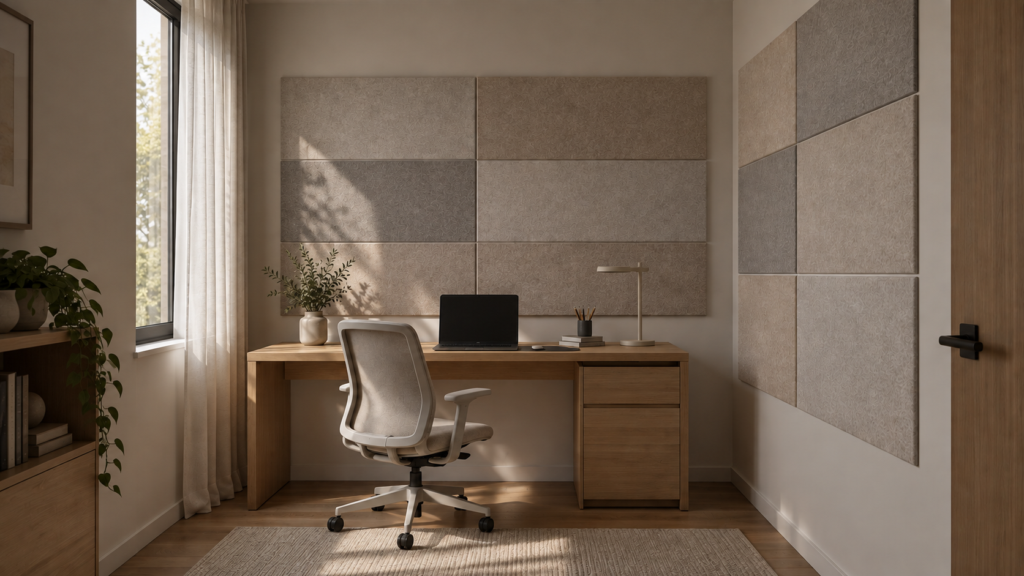
Do Acoustic Panels Work in Small Rooms?
Small rooms can develop acoustic problems surprisingly easily. A bedroom, home office, meeting room, or small studio may contain only a few hard surfaces, yet conversations can still sound harsh, video calls may be difficult to understand, and sound reflections can become distracting.
So, do acoustic panels work in small rooms?
Yes. Acoustic panels can be effective in small rooms because they absorb reflected sound and help control excessive reverberation. However, good results depend on more than simply adding as many panels as possible. Panel placement, room materials, furniture, and the type of acoustic problem should all be considered.
Why Can Small Rooms Have Acoustic Problems?
When sound is produced inside a room, it travels toward the walls, floor, ceiling, windows, and other surfaces.
Hard surfaces such as glass, concrete, tile, and painted walls reflect a significant amount of sound back into the room. In a smaller space, these surfaces are relatively close together. Therefore, reflections can return quickly and interact with the original sound.
This can make speech sound less clear or create an uncomfortable acoustic environment.
The problem may become more noticeable in modern minimalist interiors where large windows, hard flooring, bare walls, and limited soft furniture are commonly used.
However, room size alone does not determine whether a space will sound good or bad. The materials and layout of the room also play an important role.
How Do Acoustic Panels Help in a Small Room?
Acoustic panels are designed to absorb some of the sound energy that reaches their surface instead of reflecting all of it back into the room.
When panels are placed on appropriate reflective surfaces, repeated sound reflections can be reduced. As a result, speech may become clearer and the room can feel more acoustically comfortable.
This can be particularly useful in spaces such as:
- Home offices
- Bedrooms
- Small meeting rooms
- Podcast or recording spaces
- Gaming rooms
- Study rooms
- Small commercial rooms
Importantly, acoustic panels primarily improve the way sound behaves inside the room.
They should not be confused with soundproofing materials designed to reduce sound transmission from one space to another.
Not sure about the difference? Learn more about how acoustic panels reduce noise and how they differ from soundproofing.
Do Small Rooms Need More Acoustic Panels?
Not necessarily.
A small room does not automatically require a large amount of acoustic treatment. In fact, covering too many surfaces without considering the room’s purpose can result in an environment that feels unnecessarily acoustically “dead.”
Instead, existing materials should be considered first.
For example, a small bedroom containing a bed, curtains, a rug, and upholstered furniture already has several surfaces capable of absorbing some sound. Meanwhile, a meeting room of the same size with glass walls, a hard floor, and a bare ceiling may contain significantly more reflective surfaces.
Therefore, the amount of acoustic treatment should be determined by the acoustic characteristics of the room, rather than room size alone.
Where Should Acoustic Panels Be Placed in a Small Room?
Placement can be especially important when wall space is limited.
Rather than covering every wall, panels can be positioned where problematic reflections are most likely to occur. Large bare walls are often a useful place to start.
For a home office, for example, treatment may be considered around the area where conversations or video calls take place. In a meeting room, panels may be distributed across reflective wall surfaces instead of being concentrated entirely in one corner.
If wall space is limited because of windows, screens, shelving, or furniture, ceiling treatment may also be considered.
See our guide on Where Should Acoustic Panels Be Installed? Wall vs Ceiling to learn more about panel placement.
What Type of Acoustic Panel Is Suitable for a Small Room?
Several types of sound-absorbing materials can be used depending on the room’s requirements.
PET acoustic panels, for example, can be installed as wall panels while also becoming part of the interior design. Different shapes, patterns, and colors can be selected to complement the surrounding space.
For small rooms in particular, this can be useful because wall space may need to serve both functional and decorative purposes.
Instead of adding a separate decorative wall treatment and acoustic treatment, acoustic panels can sometimes perform both roles within the same design.
Can Acoustic Panels Make a Small Room Feel Smaller?
Physically, most wall-mounted acoustic panels occupy relatively little usable floor space. However, visual design can influence how spacious a small room feels.
For example, covering every wall with dark or visually heavy materials may make some interiors feel more enclosed.
Instead, acoustic treatment can be integrated selectively into the room. Neutral colors, coordinated patterns, or panels that complement the existing interior can provide acoustic functionality without dominating the space visually.
This is particularly important for bedrooms, home offices, and small commercial interiors where both acoustics and appearance matter.
What Else Can Reduce Echo in a Small Room?
Acoustic panels are not the only option.
If the acoustic problem is relatively minor, simple interior changes may already provide noticeable improvement. Rugs can soften reflective flooring, while curtains can introduce additional absorption around windows.
Upholstered furniture, fabric seating, cushions, and other soft furnishings may also contribute to a less reflective environment.
In addition, bookshelves and irregular surfaces can help break up some direct reflections.
Therefore, acoustic treatment should be considered as part of the entire room, rather than as an isolated product.
Are Acoustic Panels Worth It for a Small Room?
Acoustic panels can be worthwhile when excessive reflections are affecting speech clarity or acoustic comfort and ordinary furnishings are not providing enough absorption.
However, more panels do not automatically mean better acoustics.
Room size, ceiling height, existing materials, furniture, panel performance, placement, and the way the room is used should all be considered before deciding how much treatment is appropriate.
For a small home office, a limited amount of strategically positioned treatment may be sufficient. In contrast, a glass-heavy meeting room may require a different approach even if its floor area is similar.
Ultimately, acoustic panels for small rooms work best when they are treated as part of the room’s overall acoustic design rather than simply being added to every available surface.
About TYNE New Material Technology
TYNE New Material Technology (Thailand) Co., Ltd. is a leading manufacturer specializing in the production of interior acoustic panels and the assembly of acoustic modules. Located in Thailand, our 6,000 sqm factory employs advanced technology, including automatic production lines for polyester panels and CNC cutting equipment, to deliver a diverse range of products. From standard engineering sheets to DIY sound-absorbing kits, we cater to global markets to meet your business needs.
We adhere to strict ISO 9001:2015 quality management systems, ensuring that every container shipped meets international standards for fire safety (ASTM E84 Class A or EN 13501 Class B) and low formaldehyde emissions. Our commitment to eco-friendly production involves using recycled PET materials to create sustainable, high-quality acoustic solutions that elevate industry standards.
Looking for OEM acoustic panel manufacturing services? Contact TYNE to discuss custom acoustic panel solutions for your brand or project.
Contact us
Call: +(66) 65-237-5578
Email: support@tyneacoustic.com
Website: tyneacoustic.com