
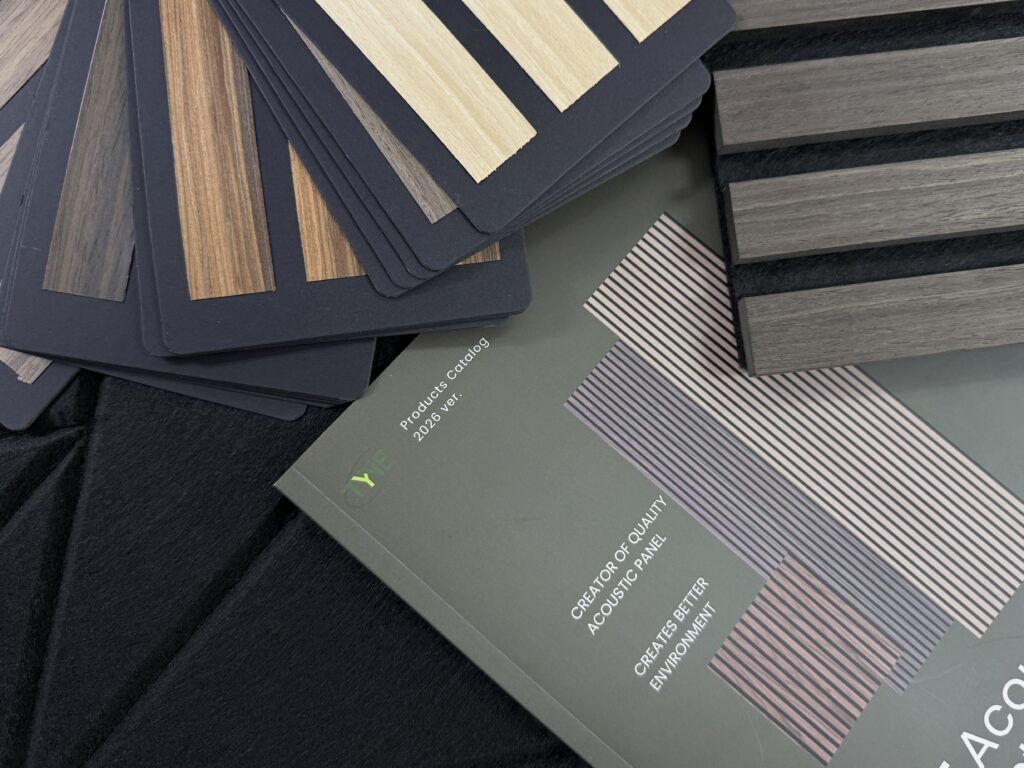
Custom acoustic panel manufacturing allows businesses to develop acoustic products according to specific requirements for dimensions, colors, patterns, surface designs, branding, and packaging. Instead of relying only on standard products, distributors, interior brands, and project suppliers can create acoustic solutions that better match their markets and applications.
However, customization involves more than simply choosing a different color. Material specifications, acoustic requirements, manufacturing feasibility, order quantity, and installation should also be considered before production begins.
So, what can actually be customized when working with an acoustic panel manufacturer?
1. Can Acoustic Panel Dimensions Be Customized?
Yes, acoustic panel dimensions can often be customized according to project or product requirements, depending on the material and manufacturing process.
Custom sizing can be useful when panels need to fit specific wall dimensions, modular systems, furniture applications, or architectural designs.
However, buyers should discuss manufacturing limitations before finalizing drawings. Material sheet sizes, cutting processes, packaging, and transportation may affect which dimensions are practical for production.
For large B2B orders, optimizing dimensions can also help reduce unnecessary material waste and simplify installation.
When developing custom acoustic panels, sound absorption should be considered alongside visual design. The Acoustical Society of America provides additional guidance on sound absorption and the use of NRC in architectural acoustics.
2. Can You Choose Custom Colors?
Yes, color customization is commonly requested for acoustic panels used in interior design and private-label product collections.
For example, PET acoustic panels can be developed in colors that complement offices, hotels, restaurants, educational spaces, and commercial interiors.
For distributors, custom colors can also help differentiate a product collection from standard products already available in the market.
Nevertheless, color expectations should be confirmed before mass production. Physical samples may be prepared so that the selected color can be evaluated under real lighting conditions.
3. Can Patterns and Shapes Be Customized?
Yes. Depending on manufacturing capabilities, acoustic panels can be cut or processed into custom shapes, grooves, patterns, and decorative designs.
This allows acoustic treatment to become part of the interior concept rather than simply being added as a functional product.
Geometric wall tiles, decorative grooves, CNC-cut designs, and modular arrangements can all create different visual effects.
However, highly complex designs should be reviewed for manufacturing feasibility before a final order is confirmed.
4. Can Acoustic Performance Be Customized?
Acoustic requirements can influence how a custom panel is developed, but visual customization should not be confused with acoustic performance.
Thickness, material properties, density, construction, installation method, and air gaps can all affect sound absorption.
Therefore, buyers should not assume that changing the shape or increasing the thickness will automatically improve performance.
When acoustic performance is important, test data such as NRC values should be considered alongside the product design.
5. Can a Manufacturer Produce Private-Label Acoustic Panels?
Yes. Custom acoustic panel manufacturing can also include private-label services for businesses that want to sell products under their own brands.
Depending on the manufacturer, customization may include product labels, cartons, packaging design, instructions, barcodes, and other brand elements.
This can be particularly useful for:
- Building material distributors
- Acoustic product brands
- Interior material suppliers
- E-commerce businesses
- Contractors and project suppliers
As a result, buyers can develop a more complete product line instead of simply reselling a generic panel.
Private Label vs OEM article here.
6. What Information Should You Send to the Manufacturer?
A clear product brief helps a manufacturer evaluate whether a custom acoustic panel can be produced and provide a more accurate quotation.
Before requesting a quote, prepare information such as:
- Product type
- Required dimensions
- Preferred color
- Thickness
- Estimated quantity
- Pattern or drawing, if applicable
- Acoustic performance requirements
- Packaging requirements
- Branding requirements
- Destination market
Reference images or technical drawings can also be provided when a specific design is required.
The clearer the initial specification is, the easier it becomes for both sides to evaluate production feasibility.
7. Should You Request a Sample Before Mass Production?
Yes. A sample is particularly valuable when a product includes custom colors, dimensions, patterns, or other specifications.
A sample allows important details to be checked before mass production begins. Depending on the project, buyers may evaluate color, texture, dimensions, workmanship, packaging, and other physical characteristics.
For this reason, the sample stage can reduce misunderstandings between the buyer and manufacturer before a larger production order is placed.
How Does the Custom Acoustic Panel Manufacturing Process Work?
Although the exact process varies between manufacturers, a typical B2B custom project may follow these steps:
Requirement → Feasibility Review → Quotation → Sample → Confirmation → Mass Production → Quality Inspection → Packaging → Shipping
Importantly, additional development steps may be required for complex designs or new product specifications.
Therefore, buyers should discuss the development process, lead time, MOQ, and approval requirements before confirming an order.
FAQ: Custom Acoustic Panel Manufacturing
What is custom acoustic panel manufacturing?
Custom acoustic panel manufacturing is the production of acoustic panels according to specific buyer requirements, which may include dimensions, colors, patterns, materials, branding, and packaging.
PET, also known as polyester when used in fiber applications, is a versatile material that can be used across a wide range of products and applications.
Can I order acoustic panels in my own brand?
Yes, if the manufacturer provides OEM or private-label services. Branding options can vary between manufacturers and should be confirmed before ordering.
Is there an MOQ for custom acoustic panels?
Usually, yes. MOQ depends on the product, material, customization level, production process, and manufacturer.
Can I send my own acoustic panel design?
Yes. Drawings, reference images, dimensions, and other specifications can be provided for a manufacturing feasibility review.
Should I order a sample first?
A sample is recommended for customized products, particularly when color, dimensions, surface design, or workmanship needs to be confirmed before mass production.
Start Your Custom Acoustic Panel Project
Custom acoustic panel manufacturing gives businesses greater control over product design, specifications, branding, and market positioning. However, successful customization depends on clear requirements and close communication between the buyer and manufacturer.
Rather than choosing customization based only on appearance, dimensions, acoustic requirements, production feasibility, packaging, and target-market needs should all be considered from the beginning.
For distributors, brands, contractors, or commercial projects developing a custom acoustic product, preparing a detailed specification is the best place to start.
About TYNE New Material Technology
TYNE New Material Technology (Thailand) Co., Ltd. is a leading manufacturer specializing in the production of interior acoustic panels and the assembly of acoustic modules. Located in Thailand, our 6,000 sqm factory employs advanced technology, including automatic production lines for polyester panels and CNC cutting equipment, to deliver a diverse range of products. From standard engineering sheets to DIY sound-absorbing kits, we cater to global markets to meet your business needs.
We adhere to strict ISO 9001:2015 quality management systems, ensuring that every container shipped meets international standards for fire safety (ASTM E84 Class A or EN 13501 Class B) and low formaldehyde emissions. Our commitment to eco-friendly production involves using recycled PET materials to create sustainable, high-quality acoustic solutions that elevate industry standards.
Looking for OEM acoustic panel manufacturing services? Contact TYNE to discuss custom acoustic panel solutions for your brand or project.
Contact us
Call: +(66) 65-237-5578
Email: support@tyneacoustic.com
Website: tyneacoustic.com