
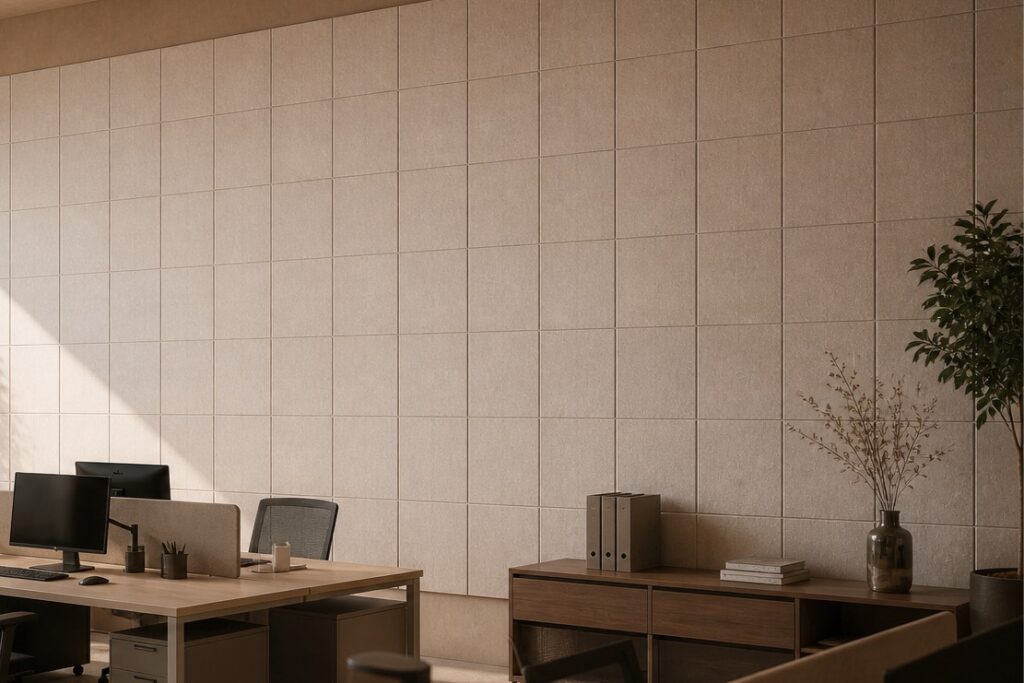
Do acoustic panels really work? This question is often asked by homeowners, designers, architects, and businesses before acoustic treatment is installed.
The answer is yes—acoustic panels can work effectively when the correct product, thickness, quantity, and placement are selected. However, they are designed primarily to absorb reflected sound inside a room. They are not usually intended to stop noise from passing through walls, ceilings, or floors.
Therefore, the effectiveness of acoustic panels depends on understanding the problem that needs to be solved. If a room sounds loud, hollow, or unclear because sound is being reflected by hard surfaces, acoustic panels can provide a noticeable improvement. On the other hand, if noise is entering from another room, a soundproofing system may be required instead.
How Do Acoustic Panels Work?
Sound travels through the air as waves. When these waves reach hard surfaces such as concrete walls, glass, tiles, or ceilings, much of the sound energy is reflected back into the room.
As a result, multiple reflections may be created. These reflections can overlap with the original sound, causing echo, excessive reverberation, and poor speech clarity.
Acoustic panels are manufactured from materials that allow part of the sound energy to enter their structure. Once the sound waves have entered, some of their energy is converted into a very small amount of heat through friction within the material.
Consequently, less sound is reflected into the room.
This process is known as sound absorption. It is especially useful in spaces where conversations, presentations, music, or customer communication must be heard clearly.
According to Saint-Gobain Ecophon, effective room acoustics can significantly improve speech intelligibility, comfort, and overall acoustic performance in commercial and educational environments.
To learn more about the principles of sound absorption and room acoustics, you can explore Armstrong’s guide to complete acoustic solution
Sound Absorption vs Soundproofing
Although the terms are sometimes used interchangeably, sound absorption and soundproofing are not the same.
Sound absorption is used to control sound within a room. It can help:
- Reduce echo
- Control reverberation
- Improve speech clarity
- Create a more comfortable acoustic environment
In contrast, soundproofing is used to reduce sound transmission between different spaces. This may require dense materials, insulated wall systems, sealed gaps, additional wall layers, or specialised doors and windows.
For example, if a meeting room sounds echoey, sound-absorbing panels may be installed. However, if conversations can be clearly heard in the neighbouring room, changes to the wall or door system may also be needed.
Therefore, the acoustic problem should be identified before a solution is selected.
What Problems Can Acoustic Panels Solve?
Acoustic panels can be highly effective when the main problem is caused by reflected sound.
They are commonly used to address the following issues:
Excessive echo
Echo may be produced when sound is strongly reflected by large, hard surfaces. Once acoustic panels are added, some of this reflected energy can be absorbed.
Long reverberation
Reverberation occurs when sound remains in a room after the original sound source has stopped. If reverberation is excessive, speech and music may become difficult to understand.
By increasing the amount of sound-absorbing material in the space, the reverberation time can be reduced.
Poor speech clarity
In meeting rooms, classrooms, restaurants, and offices, reflected sound can interfere with communication. Consequently, words may sound blurred or unclear.
When suitable acoustic treatment is installed, conversations can often be understood more easily.
Uncomfortable noise levels
Acoustic panels do not remove every sound from a room. Nevertheless, the overall acoustic environment can feel calmer because harsh reflections are controlled.
What Determines Acoustic Panel Effectiveness?
Not all acoustic panels will perform in the same way. Several factors should be considered before a product is chosen.
1. Panel material
Porous and fibrous materials are commonly used because sound waves can enter their internal structure.
For example, PET acoustic panels are produced from compressed polyester fibres. Depending on the product design and installation method, sound energy can be absorbed while a decorative finish is also provided.
2. Panel thickness
Generally, thicker acoustic materials can absorb a wider range of frequencies, particularly lower frequencies. However, thickness alone does not determine performance.
Material density, internal structure, air gaps, surface area, and installation conditions should also be evaluated.
Therefore, a thicker panel should not automatically be assumed to be suitable for every project.
3. Surface coverage
A small number of panels may provide only a limited improvement in a large room.
For more effective acoustic control, enough surface area must be covered. Nevertheless, every wall does not usually need to be completely covered.
The required amount will depend on:
- Room size
- Ceiling height
- Surface materials
- Room function
- Number of users
- Existing furniture
- Desired acoustic result
4. Panel placement
Acoustic panels should be installed where strong reflections are likely to occur.
In many rooms, useful installation areas include:
- Walls facing sound sources
- First reflection points
- Walls behind speakers
- Rear walls
- Ceilings above meeting or dining areas
- Large untreated wall sections
However, placement should be planned according to the layout and purpose of the room.
5. Air gap behind the panel
In some installations, an air gap is left between the acoustic panel and the wall or ceiling. As a result, sound absorption may be improved across a broader frequency range.
The effect will vary depending on the panel type, gap depth, and installation method.
What Is NRC?
The Noise Reduction Coefficient, commonly known as NRC, is a single-number rating used to describe the sound absorption performance of a material under specific laboratory conditions.
A material with a higher NRC generally absorbs more sound than a material with a lower rating. For example:
| NRC rating | General interpretation |
| 0.00 | Very little sound is absorbed |
| 0.30 | Some sound is absorbed |
| 0.60 | Moderate sound absorption |
| 0.80 | High sound absorption |
| 1.00 | Most tested sound energy is absorbed |
However, NRC should not be treated as the only factor when acoustic panels are selected. The rating is based on an average across particular frequencies, while real rooms contain many different sound frequencies.
Furthermore, the final result can be affected by installation, panel coverage, room geometry, and surrounding materials.
Where Are Acoustic Panels Most Effective?
Acoustic panels can be used in many residential and commercial environments.
Offices and meeting rooms
In modern offices, glass partitions, concrete floors, and open layouts are frequently used. Consequently, speech reflections and distractions may be increased.
Acoustic panels can be installed on walls, ceilings, dividers, or feature surfaces to create a more balanced environment.
Restaurants and cafés
Restaurants often contain hard surfaces that reflect conversations, music, and service noise. If acoustic treatment is added, speech may become easier to understand and the dining environment may feel more comfortable.
Classrooms and training rooms
Clear communication is essential in educational spaces. Therefore, excessive reverberation should be controlled so that instructions can be heard more clearly.
Hotels and reception areas
Acoustic materials may be used in lobbies, lounges, corridors, and meeting areas. In addition to improving acoustic comfort, decorative panels can be integrated into the interior concept.
Home offices and entertainment rooms
Acoustic panels may also be used in home offices, gaming rooms, music rooms, or home theatres where sound reflections need to be controlled.
How Quickly Can a Difference Be Noticed?
In many cases, a difference can be noticed immediately after enough acoustic treatment has been installed.
A room may sound:
- Less hollow
- Less harsh
- More controlled
- Easier for conversation
- More comfortable during extended use
However, the level of improvement will vary. A small treatment area in a large, reflective space may produce only a subtle result. In contrast, properly planned coverage can create a much more noticeable change.
For this reason, expectations should be based on the size and condition of the room rather than on the number of panels alone.
Common Mistakes When Installing Acoustic Panels
Acoustic panel performance may be reduced when installation is not planned carefully.
Installing too few panels
One decorative panel may improve the appearance of a wall, but it may not provide enough surface coverage to significantly change the room acoustics.
Placing every panel in one area
If all panels are grouped in a location with limited sound reflection, their overall impact may be reduced. Instead, strong reflection zones should be considered.
Expecting complete soundproofing
A high-performance acoustic panel can absorb reflected sound, but noise may still pass through walls, doors, windows, and ceilings.
Choosing only by appearance
Colour and design are important, especially in commercial interiors. Nevertheless, technical performance, thickness, coverage, and installation must also be reviewed.
Ignoring ceilings
In rooms with limited wall space, ceiling-mounted acoustic panels may provide an effective alternative. Additionally, ceiling treatment can be useful in large open spaces.
How to Choose the Right Acoustic Panels
Before acoustic panels are purchased, the following questions should be answered:
- Is the main problem echo, reverberation, or sound transmission?
- How large is the room?
- Which surfaces are currently reflecting sound?
- What type of activity takes place in the room?
- Is a decorative finish required?
- How much wall or ceiling space is available?
- Has tested acoustic performance been provided?
- Can the size, colour, and installation method be customised?
Once these factors have been considered, a more suitable acoustic solution can be selected.
So, Do Acoustic Panels Really Work?
Yes, acoustic panels really work when they are used for the correct purpose.
They can effectively reduce echo, control reverberation, and improve speech clarity by absorbing sound that would otherwise be reflected around a room. However, they should not be confused with complete soundproofing systems.
Ultimately, the best results are achieved when panel performance, quantity, placement, and room conditions are evaluated together.
At TYNE Acoustic, our acoustic panel solutions are developed to combine high acoustic performance with modern interior design. Whether your project involves offices, hotels, restaurants, educational facilities, or commercial buildings, our team is ready to help you find the right solution.
About TYNE New Material Technology
TYNE New Material Technology (Thailand) Co., Ltd. is a leading manufacturer specializing in the production of interior acoustic panels and the assembly of acoustic modules. Located in Thailand, our 6,000 sqm factory employs advanced technology, including automatic production lines for polyester panels and CNC cutting equipment, to deliver a diverse range of products. From standard engineering sheets to DIY sound-absorbing kits, we cater to global markets to meet your business needs.
We adhere to strict ISO 9001:2015 quality management systems, ensuring that every container shipped meets international standards for fire safety (ASTM E84 Class A or EN 13501 Class B) and low formaldehyde emissions. Our commitment to eco-friendly production involves using recycled PET materials to create sustainable, high-quality acoustic solutions that elevate industry standards.
Looking for OEM acoustic panel manufacturing services? Contact TYNE to discuss custom acoustic panel solutions for your brand or project.
Contact us
Call: +(66) 65-237-5578
Email: support@tyneacoustic.com
Website: tyneacoustic.com