
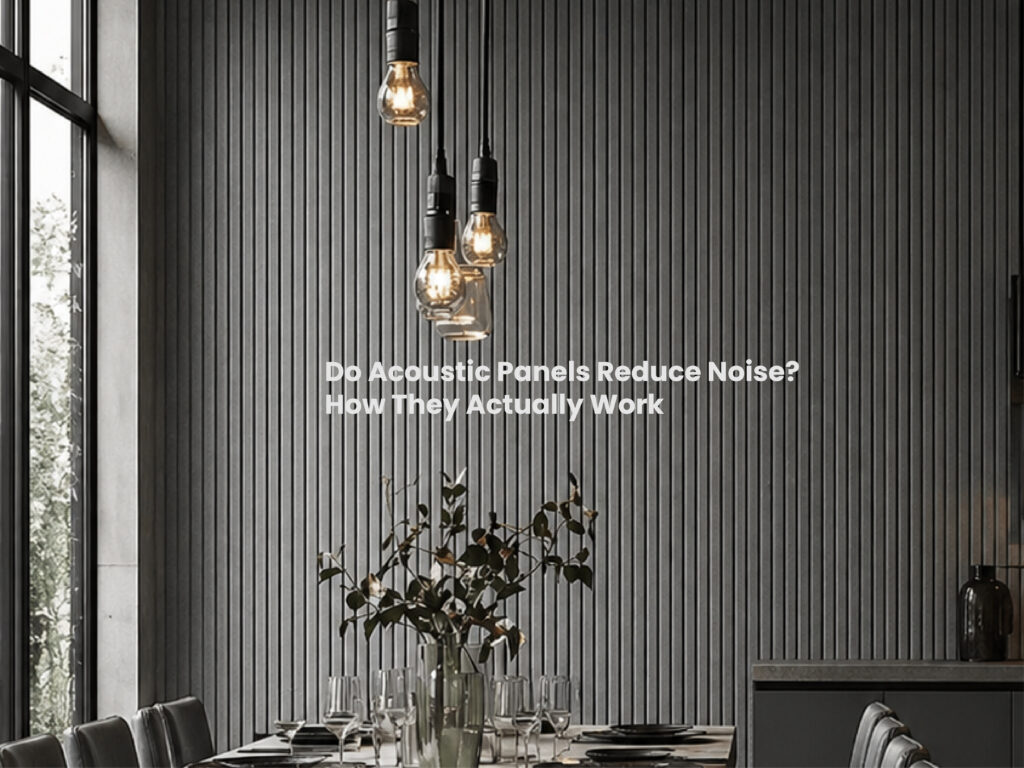
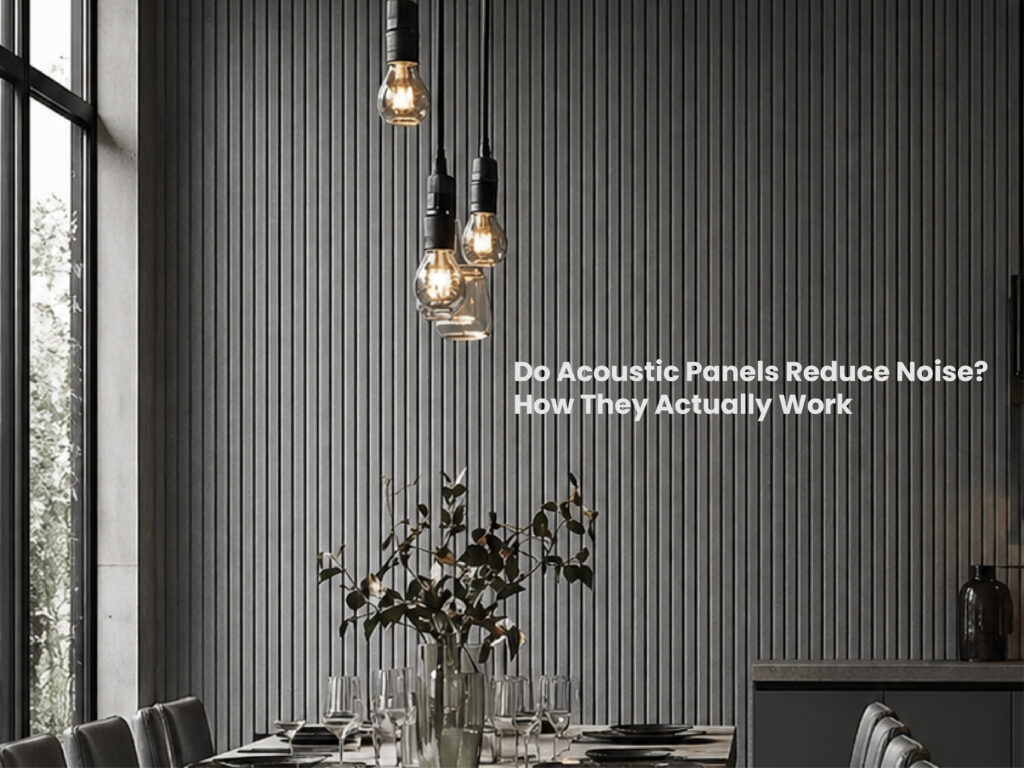
Do Acoustic Panels Reduce Noise?
Yes, acoustic panels can reduce perceived noise inside a room by absorbing reflected sound and reducing echo and reverberation. However, they are not designed to completely block sound from travelling through walls, doors, floors, or ceilings. If the goal is to prevent sound transmission between rooms, soundproofing methods may also be required.
In other words, acoustic panels make a room sound quieter and clearer, while soundproofing is intended to stop sound from entering or leaving a space.
What Do Acoustic Panels Actually Do?
Acoustic panels absorb sound reflections that would otherwise bounce between hard surfaces inside a room. As a result, reverberation can be reduced and speech can become easier to understand.
Hard materials such as glass, concrete, tiles, and painted walls reflect a significant amount of sound. In spaces with many reflective surfaces, conversations and other noises may continue to bounce around the room.
Acoustic panels are designed to absorb some of this acoustic energy rather than reflect it back into the space. Therefore, they are commonly used to improve acoustic comfort in offices, meeting rooms, restaurants, classrooms, hotels, and other commercial interiors.
Do Acoustic Panels Reduce Noise Between Rooms?
No, acoustic panels are primarily designed to control reflected sound within a room, not to prevent sound transmission between separate spaces.
This distinction is important. If you can hear people speaking through a wall, the problem involves sound isolation. In that situation, additional construction methods may be needed.
However, if voices sound unclear because your meeting room has excessive echo, acoustic treatment may be an appropriate solution.
Acoustic Panels vs Soundproofing: What’s the Difference?
The easiest way to understand the difference is to look at what each solution is designed to achieve.
| Acoustic Panels | Soundproofing | |
| Main purpose | Absorb reflected sound | Reduce sound transmission |
| Reduces echo | Yes | Not necessarily |
| Improves speech clarity | Yes | Not the primary purpose |
| Stops sound through walls | No | Designed to help |
| Typical use | Offices, restaurants, meeting rooms | Walls, ceilings, floors, doors |
Therefore, a room that sounds too echoey may benefit from acoustic panels. On the other hand, a room where outside noise is entering may require sound isolation measures.
Where Do Acoustic Panels Work Best?
Acoustic panels work best in spaces where reflected sound, echo, or excessive reverberation is causing acoustic discomfort.
Common applications include:
- Offices and open-plan workplaces
- Meeting and conference rooms
- Restaurants and cafés
- Classrooms
- Hotels
- Home offices
- Reception areas
- Commercial interiors
For example, modern offices often contain glass partitions, hard flooring, and exposed ceilings. Although these materials can create an attractive interior, sound may be reflected repeatedly throughout the space.
Consequently, acoustic treatment can help balance visual design with acoustic comfort.
If you’re planning an installation, learn Where to Install Acoustic Panels: Wall or Ceiling?
How Many Acoustic Panels Do You Need?
There is no single number of acoustic panels that works for every room. The required amount depends on room size, ceiling height, existing materials, furniture, occupancy, and the level of reverberation.
For example, a small furnished office and a large restaurant with concrete floors may require very different levels of treatment.
Therefore, acoustic panel quantity and placement should be evaluated according to the characteristics and purpose of each space.
Does NRC Matter When Choosing Acoustic Panels?
Yes. NRC, or Noise Reduction Coefficient, is commonly used to describe the sound absorption performance of a material. NRC values can help compare how effectively different acoustic materials absorb sound under specified test conditions.
However, the NRC should not be considered alone. Panel thickness, installation method, placement, and the acoustic characteristics of the room also influence the final result.
Sound absorption testing is standardized through methods such as ASTM C423, which is used to evaluate the sound absorption of acoustic materials.
Learn more about Noise Reduction Coefficient (NRC) and how acoustic panel performance is measured.
Frequently Asked Questions (FAQ)
Can acoustic panels completely soundproof a room?
No. Acoustic panels primarily absorb reflected sound inside a room. They are not designed to completely prevent sound from travelling through walls, doors, floors, or ceilings.
Do acoustic panels make a room quieter?
They can make a room feel quieter by reducing echo and reverberation. However, they do not eliminate the original sound source.
Should acoustic panels be installed on walls or ceilings?
Either location can work. The best placement depends on the room layout, reflective surfaces, sound sources, and available installation area.
Do thicker acoustic panels work better?
Not always. Thickness can influence sound absorption, particularly at different frequencies, but overall performance also depends on material properties and installation conditions.
Do acoustic panels work in offices?
Yes. Acoustic panels are commonly used in offices to control reverberation and improve speech clarity, particularly in spaces with many hard and reflective surfaces.
Do You Need Acoustic Panels?
If the main problem is echo, reverberation, or poor speech clarity, acoustic panels may be an effective solution. However, if the problem is sound travelling between rooms, additional soundproofing methods should be considered.
Ultimately, the right acoustic solution depends on the source of the problem, the room itself, and the desired acoustic result.