
Soundproofing vs Sound Absorption: What’s the Difference?
If a room is too noisy, installing acoustic panels might seem like an obvious solution. However, before choosing any acoustic material, it is important to understand soundproofing vs sound absorption.
Although these terms are often used interchangeably, they solve different acoustic problems.
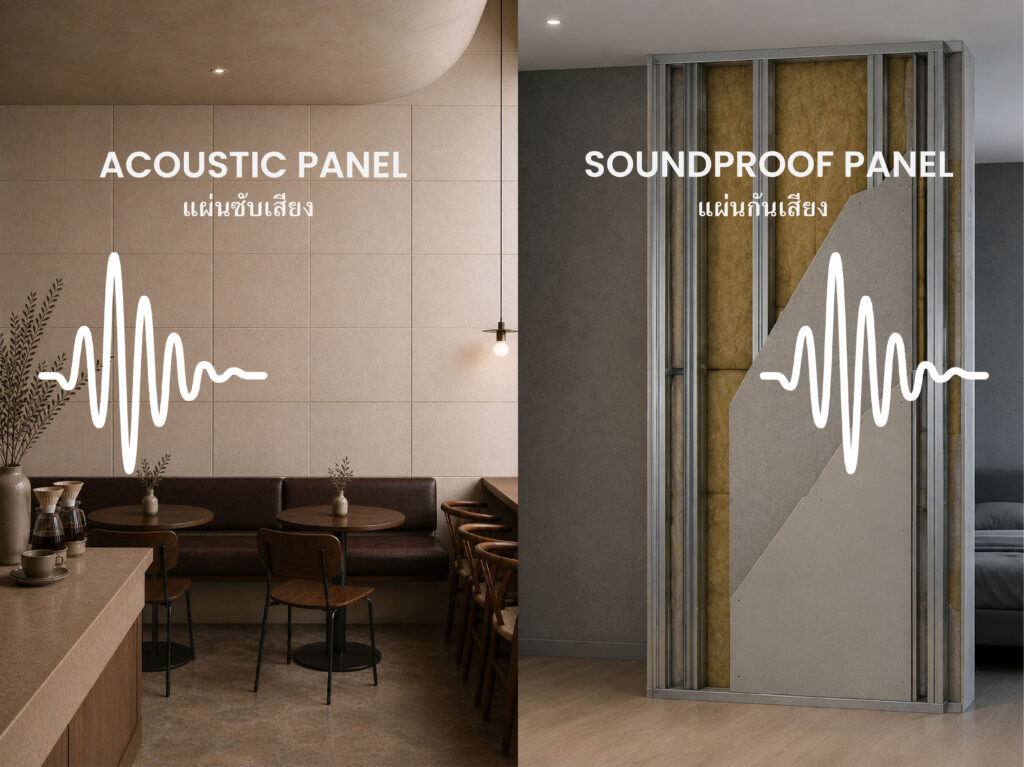
Soundproofing is primarily intended to reduce sound transmission from one space to another, while sound absorption helps control reflections, echo, and reverberation within a room.
Understanding this difference can help you choose a more appropriate solution for your home, office, restaurant, meeting room, or commercial space.
What Is Soundproofing?
Soundproofing refers to methods used to reduce the amount of sound traveling between separate spaces.
Imagine that you can hear traffic through a wall, conversations from the room next door, or music coming through the ceiling. In these situations, the problem involves sound transmission.
Effective soundproofing usually requires attention to the construction of the room. Depending on the project, strategies may involve adding mass, separating structural elements, sealing air gaps, improving doors and windows, or creating multi-layer wall and ceiling assemblies.
For example, even a small opening around a door can allow sound to pass between spaces. Therefore, the overall construction system needs to be considered rather than focusing on one surface alone.
In many cases, soundproofing is easiest to plan during construction or renovation.
What Is Sound Absorption?
Sound absorption deals with a different problem.
When sound is produced inside a room, it travels until it reaches walls, ceilings, floors, windows, furniture, and other surfaces. Hard materials such as glass, concrete, tile, and painted walls can reflect a significant amount of that sound back into the room.
If too many reflections are present, the space may sound echoey or excessively reverberant.
Sound-absorbing materials are used to reduce some of these reflections. Instead of allowing all incoming sound energy to be reflected back into the room, part of that energy is absorbed by the material.
The difference between controlling sound inside a room and preventing sound transmission is important when selecting acoustic materials. Primacoustic provides a useful explanation of how sound absorption and soundproofing address these different acoustic problems.
Common examples include acoustic panels, acoustic ceiling products, certain soft furnishings, carpets, and other porous sound-absorbing materials.
As a result, speech clarity and overall acoustic comfort may be improved.
Learn more about how acoustic panels reduce noise and control sound reflections.
Soundproofing vs Sound Absorption: Key Differences
The easiest way to understand the difference is to consider where the unwanted sound is coming from.
| Soundproofing | Sound Absorption | |
| Main purpose | Reduce sound transmission | Reduce sound reflections |
| Problem | Noise entering or leaving a room | Echo and reverberation inside a room |
| Where it works | Building structure | Interior surfaces |
| Typical solutions | Walls, insulation systems, doors, windows, seals | Acoustic panels, ceiling panels, baffles, soft materials |
| Renovation | Often required | Often can be added afterward |
| Acoustic panels | Not usually a complete solution | Commonly used |
For example, if conversations from the next office can clearly be heard through the wall, adding wall-mounted acoustic panels alone is unlikely to solve the underlying transmission problem.
However, if conversations inside the office are difficult to understand because sound is repeatedly reflected from glass walls and hard floors, sound absorption may be the more relevant approach.
Do Acoustic Panels Soundproof a Room?
This is one of the most common misconceptions about acoustic panels.
Acoustic panels are primarily sound-absorbing products, not complete soundproofing systems.
Their purpose is generally to control reflected sound within a space. Therefore, they can help reduce excessive reverberation and improve room acoustics, but they should not be expected to completely prevent sound from passing through a wall.
For example, installing PET acoustic panels in a meeting room may make conversations clearer inside the room. However, if speech is traveling through a lightweight partition into the room next door, the wall construction may also need to be addressed.
This distinction is important because choosing the wrong solution can result in additional cost without solving the actual acoustic problem.
How Do You Know Which One You Need?
Before choosing acoustic materials, identify the problem first.
Ask yourself:
Is unwanted sound coming from another room or from outside?
If yes, the issue may involve sound transmission, meaning that soundproofing should be investigated.
Does the sound feel harsh, echoey, or difficult to understand inside the room?
If yes, the issue is more likely related to reflections and reverberation, making sound absorption relevant.
Sometimes, both problems exist at the same time.
A restaurant, for example, may have excessive reverberation inside the dining area while traffic noise also enters through the building envelope. Similarly, an office may require better speech privacy between meeting rooms while also needing absorption to improve speech clarity inside each room.
Therefore, soundproofing and sound absorption should not always be viewed as competing solutions. They can serve different purposes within the same acoustic design.
Where Are Sound-Absorbing Panels Most Useful?
Sound-absorbing panels can be useful in spaces where excessive reflections interfere with comfort, communication, or the intended use of the room.
Examples include:
- Offices and meeting rooms
- Restaurants and cafés
- Classrooms
- Home offices
- Recording and podcast rooms
- Conference rooms
- Hotels
- Commercial interiors
In these environments, panels can be installed on selected wall or ceiling surfaces to introduce additional absorption.
However, placement matters. Simply covering one small area may not adequately address reflections throughout the room.
See Where Should Acoustic Panels Be Installed? Wall vs Ceiling to understand how placement can influence acoustic treatment.
What Materials Are Used for Sound Absorption?
Different materials can be selected depending on the acoustic requirements, interior design, installation method, and application.
One option is PET acoustic panels, which are commonly used as interior wall or ceiling treatments. Because they can be produced in different colors, shapes, patterns, and configurations, acoustic performance can be incorporated into the visual design of a space.
Other solutions may include acoustic ceiling systems, suspended baffles, fabric-covered absorbers, carpets, curtains, and upholstered furnishings.
Importantly, not every soft material provides the same acoustic performance. When measurable performance is required, tested acoustic data such as the Noise Reduction Coefficient (NRC) can help compare how materials absorb sound under standardized test conditions.
Can You Reduce Echo Without Soundproofing?
Yes. If the main problem is reflected sound rather than noise transmission, structural soundproofing may not be necessary.
For minor acoustic problems, rugs, curtains, upholstered furniture, and other soft materials can help introduce additional absorption.
For rooms with extensive hard surfaces or more demanding acoustic requirements, dedicated acoustic panels may provide a more targeted solution.
This is particularly useful when a building has already been completed and major renovation is undesirable.
Discover how to reduce echo in a room without renovating with seven practical approaches.
→ Link ไป How to Reduce Echo in a Room Without Renovating
Soundproofing or Sound Absorption: Start With the Problem
The difference between soundproofing vs sound absorption becomes much easier to understand when you focus on the source of the problem.
If unwanted sound is traveling between rooms, through a wall, door, ceiling, floor, or window, soundproofing methods may need to be considered.
If the problem is happening within the room because sound is reflecting from hard surfaces, sound absorption may be the more appropriate approach.
In some projects, both strategies may be required.
Therefore, before selecting acoustic materials, identify whether you are trying to block sound transmission, control sound reflections, or achieve both. Once that distinction has been made, an acoustic solution can be selected more effectively.
About TYNE New Material Technology
TYNE New Material Technology (Thailand) Co., Ltd. is a leading manufacturer specializing in the production of interior acoustic panels and the assembly of acoustic modules. Located in Thailand, our 6,000 sqm factory employs advanced technology, including automatic production lines for polyester panels and CNC cutting equipment, to deliver a diverse range of products. From standard engineering sheets to DIY sound-absorbing kits, we cater to global markets to meet your business needs.
We adhere to strict ISO 9001:2015 quality management systems, ensuring that every container shipped meets international standards for fire safety (ASTM E84 Class A or EN 13501 Class B) and low formaldehyde emissions. Our commitment to eco-friendly production involves using recycled PET materials to create sustainable, high-quality acoustic solutions that elevate industry standards.
Looking for OEM acoustic panel manufacturing services? Contact TYNE to discuss custom acoustic panel solutions for your brand or project.
Contact us
Call: +(66) 65-237-5578
Email: support@tyneacoustic.com
Website: tyneacoustic.com